Seven Days on KDP: 370 Page Reads, Zero Sales, and a 24-Hour Window
Two AI-drafted novels went live on October 17. One week later the dashboard shows 370 Kindle page reads and no sales — and every one of those pages was read on a single day. The split is the interesting part: 351 pages belong to book one, which means at least two readers finished it, and 19 belong to book two, which means one reader opened it and stopped. Here is what a 24-hour exposure window looks like, and what it does and does not prove.
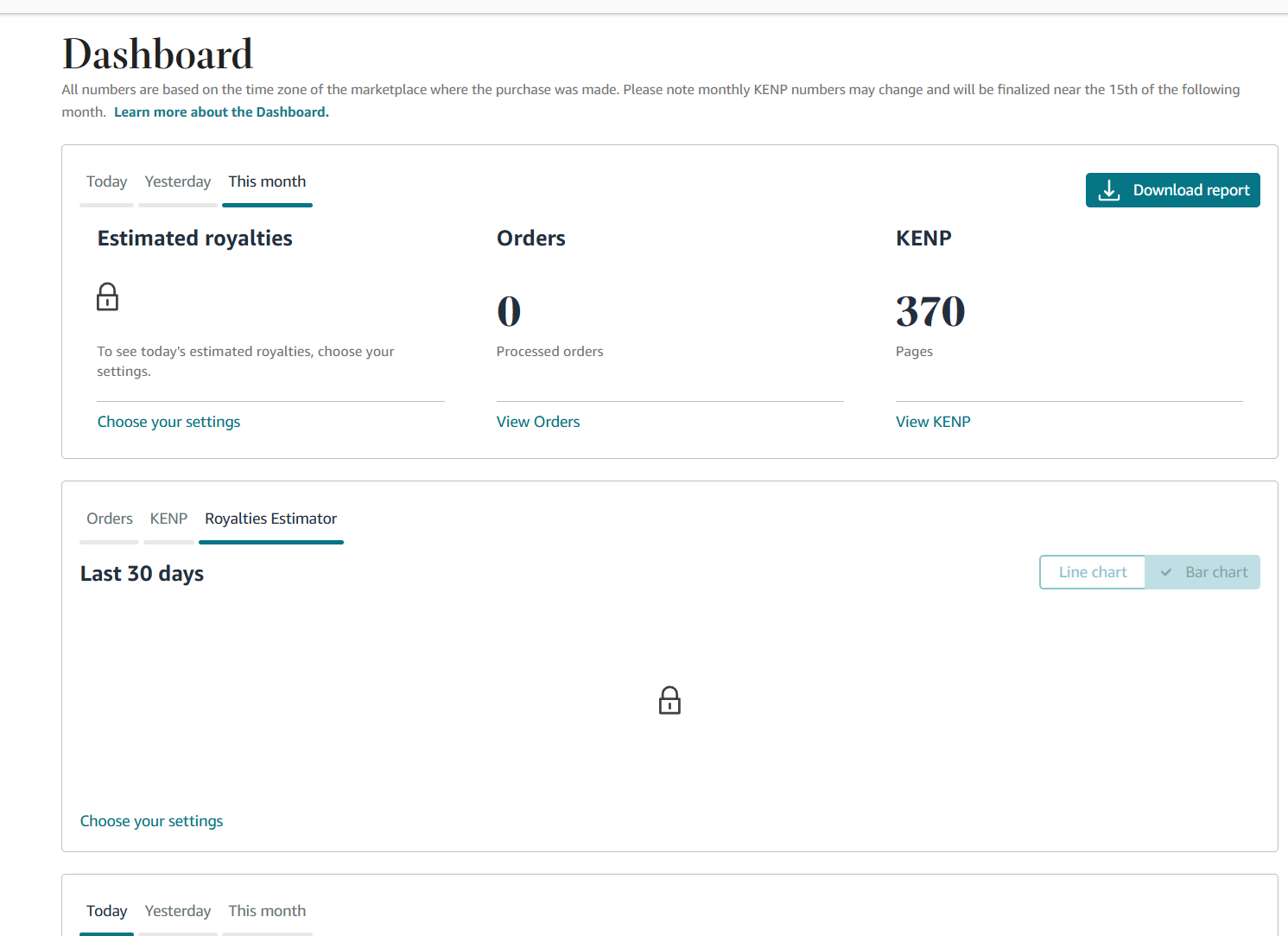
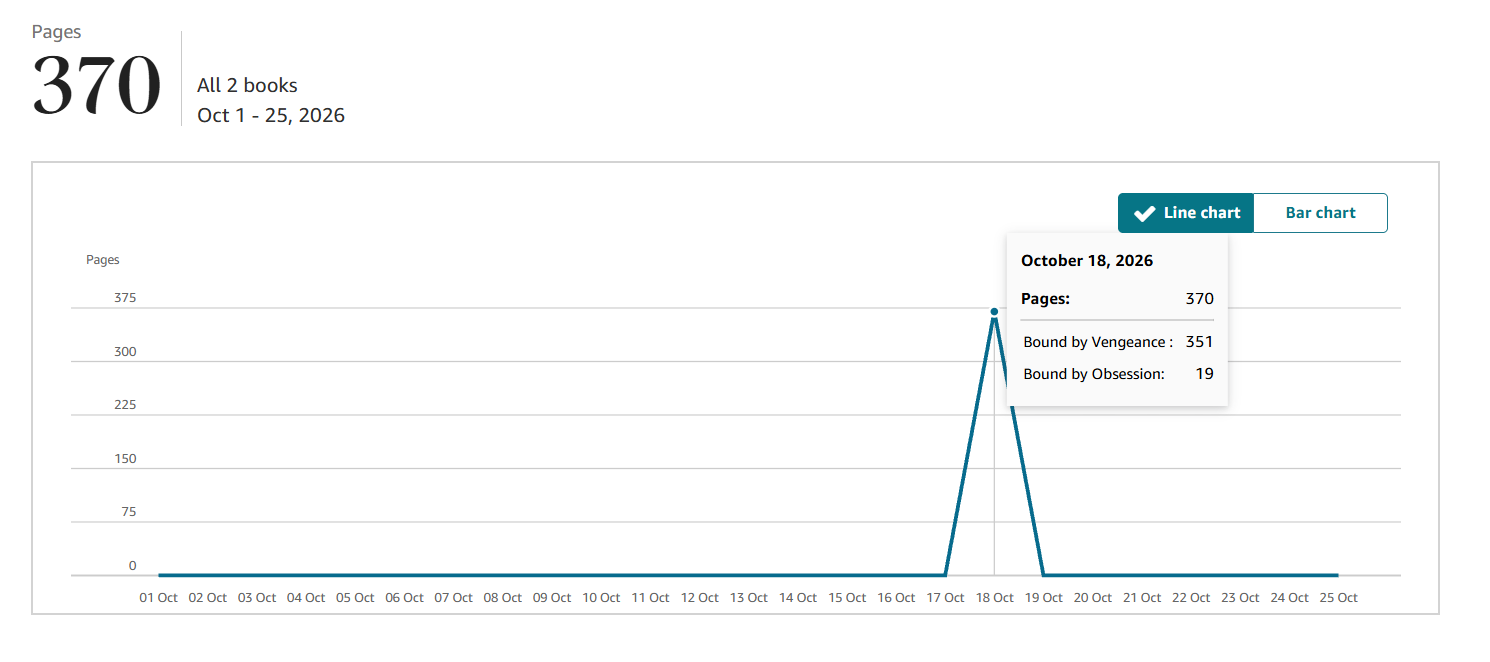
The short version: the two novels we published on October 17 have produced 370 Kindle Edition Normalized Pages (KENP) read and zero sales — and all 370 pages were read on October 18, the second day the books were live. From October 19 through October 25 the counter stayed at zero.
The split matters more than the total. 351 pages belong to book one, which is 258 pages long, so at least two readers finished it. 19 pages belong to book two — someone opened the sequel and stopped a few pages in. No advertising, no reviews, store rank 535,297.
That shape — a burst on day two, then silence — is the most useful thing this experiment has produced so far, and it is not the shape I expected.
This is the one-week report, including the parts that are not flattering.
What the dashboard actually says
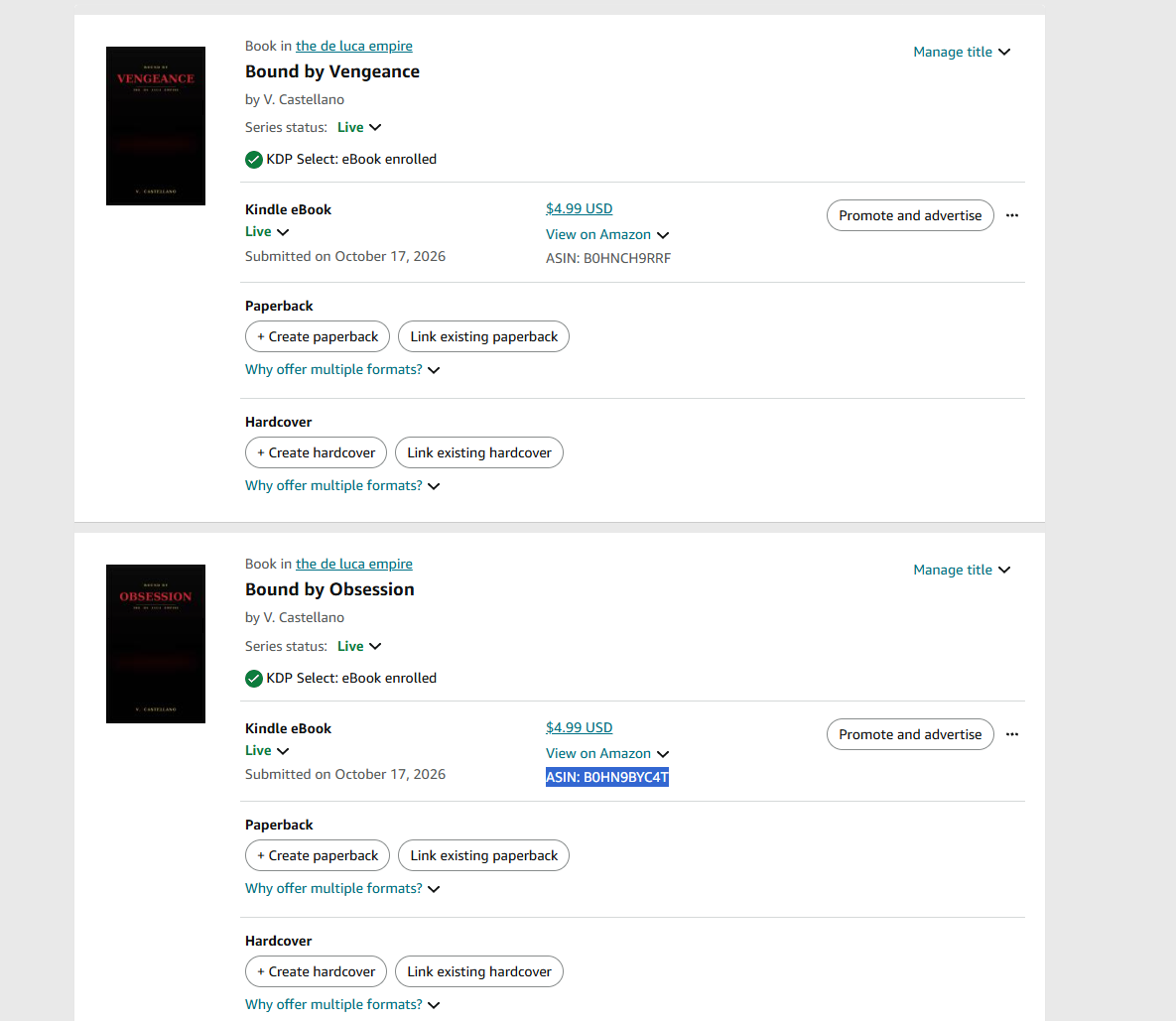
| Bound by Vengeance (Book 1) | Bound by Obsession (Book 2) | |
|---|---|---|
| ASIN | B0HNCH9RRF | B0HN9BYC4T |
| Published | 2026-10-17 | 2026-10-17 |
| Page count | 258 | 294 |
| Price | $4.99 | $4.99 |
| Kindle Store rank | #535,297 | not ranked |
| Category rank | #6,611 Dark Romance / #7,030 Romantic Suspense | none |
| Reviews | 0 | 0 |
| KDP Select | enrolled | enrolled |
| Paperback | not created | not created |
Both books went live within 48 hours of upload, which is the only part of this process that behaved exactly as advertised. Everything after that has been a lesson in how little a listing does on its own.
The split that matters
KENP pages are not the same as print pages. Amazon normalizes each book to its own page count, and it pays only for the first read by a given customer — a re-read generates nothing. That rule is what makes the split readable:
370 total pages read
├─ 351  → book one (258 pages)
└─  19  → book two (294 pages)
One customer cannot generate 351 pages on a 258-page book, because the cap is the book itself:
351 ÷ 258 = 1.36So at least two people finished book one — one read it end to end, the other read most of it. On book two, 19 pages is a single reader opening the sequel and stopping inside the first chapter. That is not a returning fan; that is a browse that ended.
Then the timing. All 370 pages landed on October 18. Nothing on the 17th, the day the books went live. Nothing from the 19th onward.
What that shape means
New KDP titles get a short exposure window. For roughly a day after a book goes live, the store surfaces it to Kindle Unlimited readers browsing the category. After that, position is a function of sales rank and reviews — and our books had neither, so the window closed.
What happened on October 18 was the algorithm’s default allotment, not an audience that was starting to build. The books were shown to a handful of people once. Two of them finished. Then the shelf went dark.
This changes the read on the experiment in a way that is worth stating plainly:
| What the data proves | What it does not prove |
|---|---|
| Two strangers finished a 258-page book from an unranked, unreviewed debut | Anything about scale — scale was never tested |
| KU can put a new title in front of readers without ads | That the book sells, or that the cover works |
| The story holds a reader to the end once they start | That more exposure would produce more finishes |
This is a new line for us, opened deliberately as a test rather than a bet. The two novels are the first titles in a planned five-book series, and the publishing pipeline behind them is unglamorous on purpose: draft, check, package, upload, measure. Week one is the baseline — what the algorithm does with no money behind it.
Why page reads are a cleaner signal than sales
In Kindle Unlimited, a subscriber does not buy the book. They borrow it, and the author is paid per page read out of a monthly pool. The rate moves around; the US rate has been roughly $0.0048–0.0053 per page through 2026.
Two properties of that system make it useful as a test:
The reader has to keep going. You are paid for pages actually read, not for downloads. A reader who bounces on page three generates almost nothing. A reader who finishes 258 pages generates 258 pages of revenue, which is a much stronger statement about the book than a $4.99 sale followed by a refund.
The signal is not gated by price. A $4.99 ebook with zero reviews is a hard sell to a stranger. The same book inside a subscription they already pay for is a zero-marginal-cost decision. KU gave us a way to be read by someone who would never have taken a chance on an unranked, unreviewed debut.
At the current US rate, 370 pages is worth about two dollars. That is not the point. The point is that the two dollars were generated by people who chose to keep reading, not by people who downloaded and left.
What page reads do not prove
Four things, and each one is a hole I can see in the bookshelf:
1. Zero reviews. KU readers do not leave reviews. They have no purchase to justify and no incentive to write one. A book with no reviews and a rank in the five hundred thousands is effectively invisible to search. Reviews are the lever that moves rank, and right now the lever does not exist.
2. Book two is not ranked at all. Book one at least reached #535,297 and picked up two category ranks. Book two is not on any list. A reader who finishes book one and goes looking for book two may not find it through any surface other than the series link on the product page.
3. No paperback. Kindle and print are separate listings on Amazon, with separate ranks and separate browse paths. A meaningful share of dark romance readers buy print exclusively, and right now they cannot buy ours. Print on demand costs nothing up front, carries no inventory, and prices at $12.99–16.99 with a higher royalty per unit than the ebook.
4. No advertising. The “Promote and advertise” button has never been pressed. Amazon Ads is the one channel here where you can buy a known quantity of targeted traffic today rather than growing it over months: sponsored placements on competitor product pages, where the audience is already looking for this exact category.
That last point is the real finding of the week. The product side is working. Distribution has not been switched on yet — and on a subscription platform, that is a switch you can flip in an afternoon.
The question everyone asks: can’t AI reading inflate this?
This came up immediately when I showed the number to someone, and it is a fair challenge, because a large share of AI-published books are also the kind of book that attracts page-read manipulation.
The answer is no, and the reason is structural. KENP is only counted when all of the following are true:
- the reader has an active Kindle Unlimited subscription;
- the reading happens inside a Kindle device or the Kindle app;
- progress is recorded as pages turned, not as a download;
- it is the first time that customer has read those pages — re-reads are not paid, and a single customer is capped at 3,000 KENP per title.
Scraping the book, feeding a PDF to a chat model, or converting the text and reading it elsewhere does not touch Kindle’s reading state and therefore generates nothing. Kindle’s own text-to-speech does count, because the app is still turning pages. Automated page-turning on a real KU account is the one method that lands in the report — and Amazon screens for it, removes the pages, and treats repeat behavior as account-level fraud.
So 370 pages on a book with no promotion is either real reading or the most pointless fraud in the world. The shape also argues for real: the pages land in a single day, which is exactly what a new-title exposure window produces, and 19 pages on the sequel is an odd thing for a bot to bother doing.
The money, plainly
Nobody should read this as a revenue post. Here is the actual cash position:
- 370 pages × ~$0.0053 = approximately $2, and it will move with the pool rate.
- Royalties for October are paid roughly 60 days after the month closes, so this money lands at the end of December, not now.
- The payments page is empty today for that reason alone, not because anything is broken.
- With an EFT payout to a US bank account there is no minimum threshold; with a wire there is a $100 floor. Ours is EFT, so the two dollars will actually arrive.
Two housekeeping items decide whether that payment clears: the payout method has to finish verification, and the W-8BEN-E has to be accepted. Both are worth checking before the first statement, not after.
What I am testing next
One experiment, seven days, seventy dollars:
Run Amazon Ads at $5/day against the dark romance category, with placements on comparable titles. The question is not whether the book can sell at $4.99 with no reviews. It is whether the book converts when a targeted reader actually sees it. Those are different questions, and only the second one is worth building a series on.
If the click-to-read rate is reasonable, the answer is more books and more budget. If it is near zero, the problem is upstream of the ad: cover, blurb, or the first three pages. Those are cheap to fix and stupid to guess at.
Alongside that, two free moves: publish the paperback for book one, and put a review request and a book-two link on the last page of the ebook. Neither costs anything, and both address holes that are visible in the dashboard today.
The summary: this line is one week old, and the algorithm gave it one day. Two strangers finished book one. One opened book two and stopped nineteen pages in. Then the window closed and the counter went to zero for the rest of the week.
Two dollars is not a business, and this post does not claim it is. What it does claim is narrower: at a cold start, with no ads and no reviews, the book held two readers to the end. The sequel did not hold the one reader who tried it — that is the first real editorial signal, and it points at book two’s opening pages, not at the cover.
The next seven days and seventy dollars will tell us whether a targeted reader behaves the same way. If they do, the constraint is exposure. If they do not, the constraint is the book.